
Laparoscopic (Keyhole) Surgery: When Is It Better Than Open Surgery?
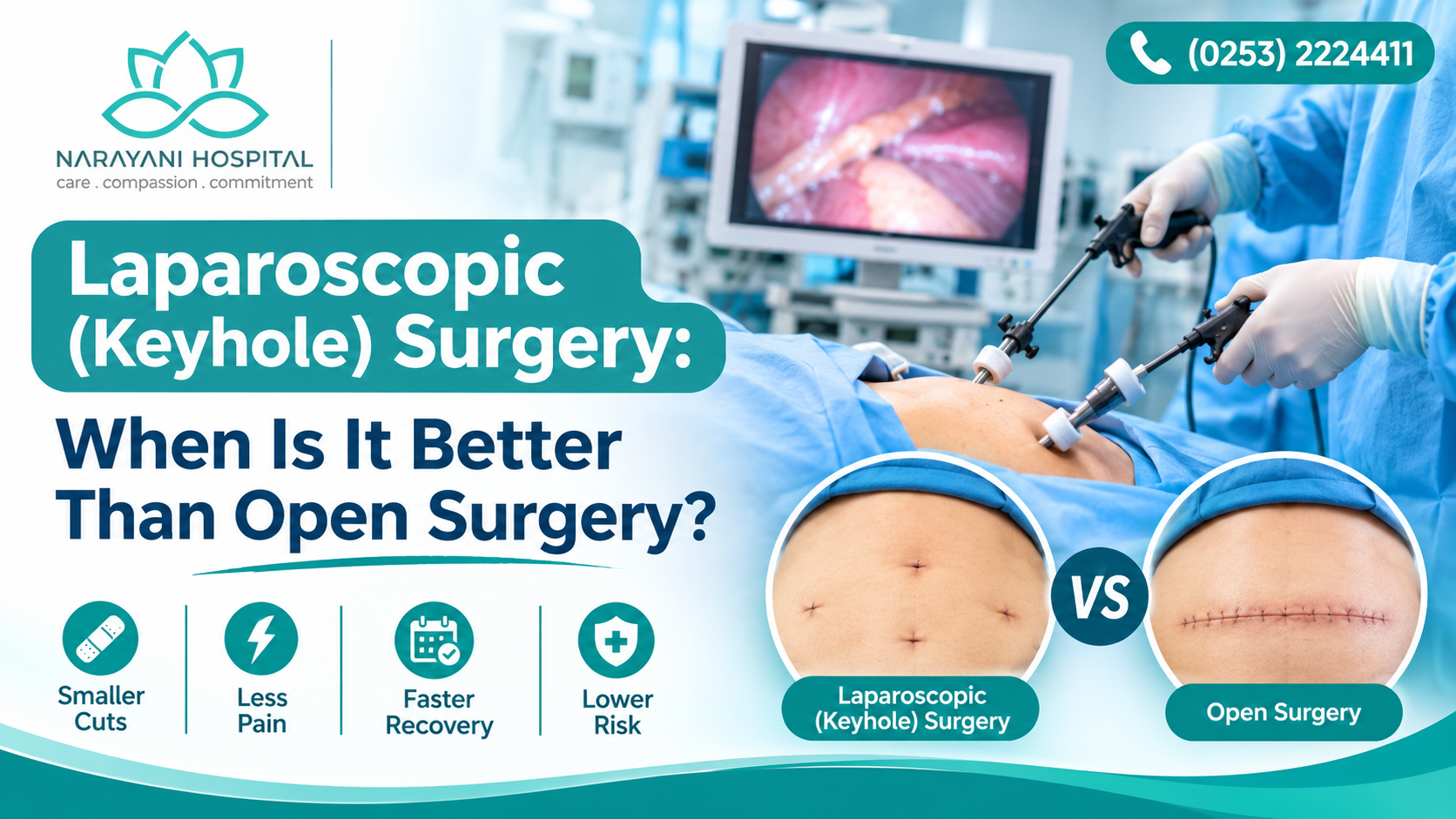
When a doctor says you need surgery, the first reaction is usually worry. The second question is almost always the same: “Will it be a big cut?” For many operations today, the answer can be no. Laparoscopic surgery, often called keyhole surgery, lets surgeons operate through a few tiny openings instead of one long incision.
It is not right for every patient or every condition, though. Sometimes traditional open surgery is the safer choice. At Narayani Hospital, we believe patients should understand both options so they can take part in the decision. Here is a simple guide.
What Is Laparoscopic Surgery?
Laparoscopic surgery is a form of minimally invasive surgery. Instead of opening the abdomen with a large cut, the surgeon makes several small incisions, usually around half a centimetre to one and a half centimetres long. Through these openings, a thin tube with a camera and light, called a laparoscope, and slim surgical instruments are passed inside the body.
Open surgery, in contrast, uses a longer incision so the surgeon can see and reach the organs directly. Both approaches aim for the same result. The difference is in how the surgeon gets there.
How Does Keyhole Surgery Work?
- Anaesthesia. Most laparoscopic operations are done under general anaesthesia, so you are asleep and feel nothing.
- Small incisions. The surgeon makes a few tiny cuts in the abdomen, often three or four.
- Creating space. Carbon dioxide gas is gently pumped into the abdomen. This lifts the wall away from the organs, giving the surgeon room to work and see clearly.
- The camera view. The laparoscope sends a magnified, high-definition image to a monitor. The surgeon operates by watching this screen.
- The procedure. Long, thin instruments are used to cut, remove, repair or stitch tissue. Any organ or tissue that needs to be removed is taken out through one of the small openings.
- Closing up. The gas is released, the instruments are withdrawn, and the small cuts are closed with a few stitches or surgical glue.
Common Procedures Done by Keyhole Surgery
A wide range of planned (elective) abdominal and pelvic operations can be done laparoscopically. Some of the most common are:
- Gallbladder removal (cholecystectomy) for gallstones. This is one of the most frequently performed keyhole operations.
- Appendix removal (appendectomy) for appendicitis.
- Hernia repair, including inguinal (groin) and incisional hernias.
- Gynaecological surgery, such as removal of ovarian cysts and fibroids, and hysterectomy.
- Urological surgery, such as certain kidney and ureter operations.
- Bowel surgery, for selected conditions of the intestine and colon.
- Weight-loss (bariatric) surgery for severe obesity.
- Diagnostic laparoscopy, where a camera is used to look inside the abdomen to find the cause of pain or infertility, and sometimes to treat it at the same time.
The Main Benefits of Laparoscopic Surgery
Because the incisions are small, the body goes through less trauma. For suitable patients, this often means:
- Smaller cuts and less scarring. Instead of one long scar, you have a few tiny marks that fade over time.
- Less pain after surgery. Many patients need fewer strong painkillers.
- Shorter hospital stay. Many patients go home within a day or two, depending on the operation.
- Faster return to normal life. People can usually walk, eat and get back to light activity and work sooner than after open surgery.
- Lower risk of wound problems. Smaller wounds mean fewer wound infections and less chance of some types of hernia at the scar.
- Better view for the surgeon. The camera magnifies the area, which can help with precision.
Studies back this up for common operations. Reviews of laparoscopic appendectomy show shorter hospital stays and quicker return to normal activity and work compared with open surgery. In one hospital study of acute appendicitis, complications were noticeably lower after the laparoscopic approach, while the operating time was similar.
Is Keyhole Always Better? An Honest Look
No. Laparoscopic surgery has real advantages, but it also has limits:
- It can take longer in some operations, particularly complex ones.
- It needs special equipment and training. The results depend heavily on the surgeon’s experience and the hospital’s setup.
- Not all operations show a big advantage. For some procedures, such as gallbladder removal, complication rates are similar to open surgery. The main gains are comfort and recovery.
- It may cost more in some settings because of the specialised instruments used.
- Some side effects are particular to it. Shoulder-tip pain is common for a day or two, caused by the gas used during surgery.
- Conversion to open surgery is sometimes needed. If the surgeon cannot see clearly or finds unexpected bleeding, scarring or inflammation, they may switch to an open incision for your safety. This is a safety decision, not a failure.
When Open Surgery May Be the Better Choice
Your surgeon may recommend open surgery if:
- You have had several earlier abdominal operations, which can leave dense scar tissue (adhesions).
- The infection or inflammation is severe, or an organ has already burst.
- There is heavy, uncontrolled bleeding or you are very unstable in an emergency.
- A large tumour or mass cannot be safely removed through small openings.
- You have a serious heart or lung condition that may not tolerate the gas pressure and the body position used in keyhole surgery.
- The anatomy is unclear and it is safer to see and feel the area directly.
Being overweight does not rule out keyhole surgery, but it can make the operation more technically challenging and slightly raises the chance of conversion to open surgery.
Who Is Suitable for Laparoscopic Surgery?
The best way to know is a consultation with a surgeon. In general, keyhole surgery works well for people who:
- Need a planned operation on the gallbladder, appendix, hernia, ovaries, uterus or similar organs
- Are fit enough for general anaesthesia after a routine pre-operative check-up
- Have a condition that the surgeon can safely reach with small instruments
Age alone is not a barrier, as older adults often benefit greatly from smaller wounds and a quicker recovery. What matters most is your overall health, the exact condition being treated, and any earlier surgeries. Your surgeon will review your scans, blood tests and medical history before recommending an approach.
What to Expect During Recovery
- The first day: You will be encouraged to sit up and take a few steps. Early movement helps prevent clots and speeds healing.
- Pain and bloating: Mild soreness at the incisions and some bloating or shoulder pain are common and settle in a few days.
- Eating: Most people can return to light food quickly, as advised by the surgeon.
- Activity: Many people return to desk work within one to two weeks, though this varies with the surgery. Avoid heavy lifting and strenuous exercise until your surgeon gives the go-ahead.
- Wound care: Keep the small wounds clean and dry, and follow your discharge instructions.
When to Call Your Doctor After Surgery
Contact your surgeon or visit the emergency department if you have:
- Fever or chills
- Pain that is getting worse instead of better
- Repeated vomiting, or a swollen, hard abdomen
- Redness, swelling or discharge from a wound
- Yellowing of the skin or eyes
- Breathlessness, chest pain, or a painful, swollen leg
Questions to Ask Your Surgeon
- Is laparoscopic surgery suitable for my condition, and why?
- How often do you perform this operation by the keyhole method?
- What is the chance that my surgery will need to be converted to open surgery?
- How long will I stay in hospital, and when can I go back to work?
- What are the risks and the costs of each option?
Care You Can Trust in Nashik
At Narayani Hospital, our doctors take time to explain your diagnosis, discuss your surgical options, and recommend the approach that is safest for you, whether that is keyhole or open surgery. We accept walk-ins, offer same-day appointments, and run a 24/7 emergency unit.
📍 Narayani Hospital, Next to Shree Vallabh Apartment, behind Chhan Hotel, Mumbai Naka, Deepali Nagar, Nashik,
Maharashtra 422009
📞 (0253) 2224411
Final Thoughts
Laparoscopic surgery has changed the way many common operations are done. For the right patient, it offers smaller scars, less pain and a quicker return to everyday life. But the best operation is the one that is safest for your condition, and sometimes that is the open one. A frank discussion with your surgeon will help you choose with confidence.
Disclaimer: This article is for general awareness and does not replace professional medical advice. Please consult a qualified doctor for diagnosis and treatment.