
How Many Steps a Day Do You Really Need?
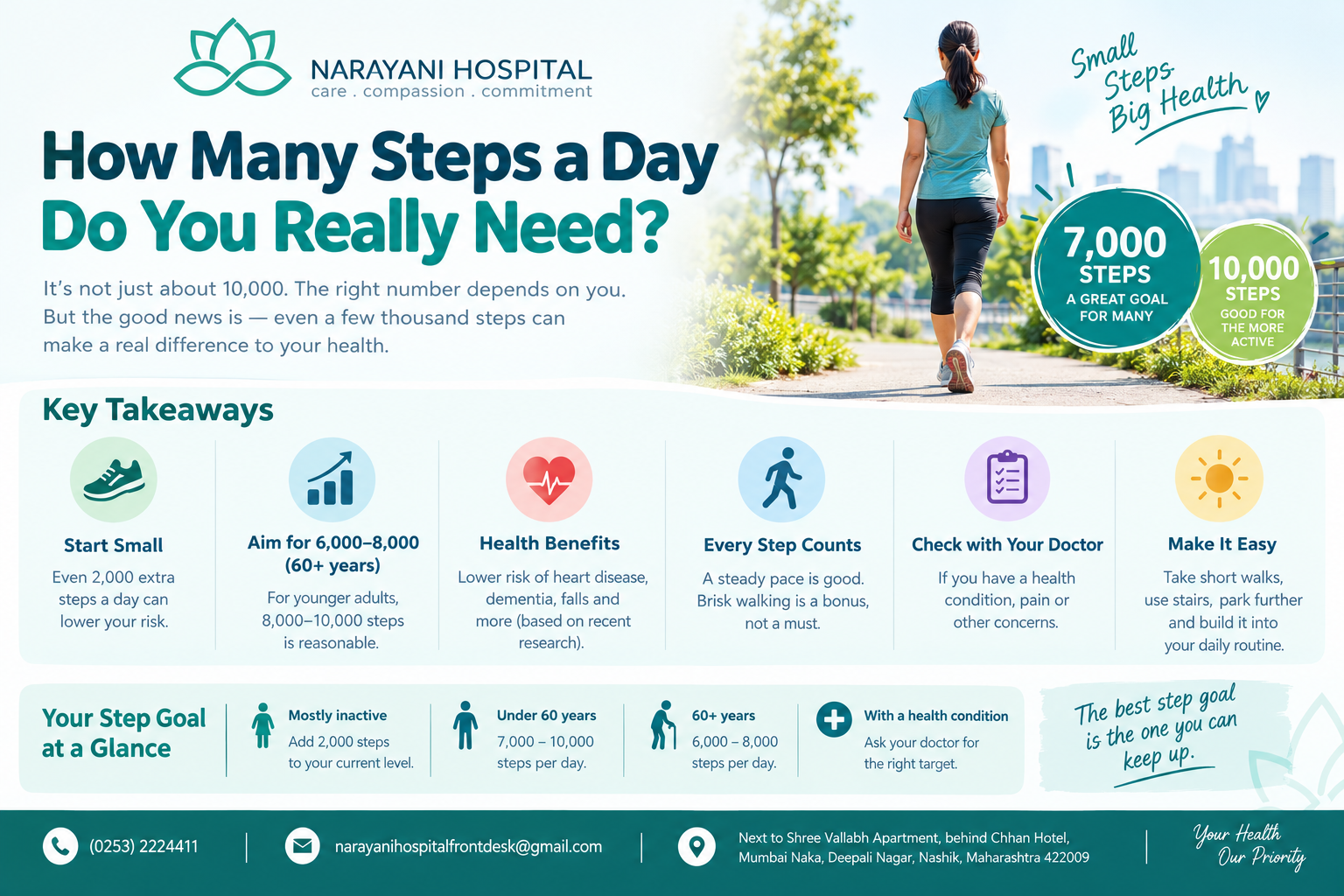
If you own a smartwatch or a fitness app, you have probably seen the little notification that says “Goal: 10,000 steps.” Maybe you hit it on a good day and felt great. Maybe you fell short on most days and felt a bit guilty. Either way, you may have wondered: where did this number come from, and do I really need to reach it?
At Narayani Hospital, patients ask us this often. People want a simple answer to a simple question. The honest answer is that the right number depends on you, but the research is more encouraging than most people expect.
Where Did the 10,000-Step Rule Come From?
The figure did not come from a medical study. It goes back to a Japanese pedometer marketed in the 1960s, and the number was chosen largely because it was catchy and easy to remember. It stuck, and over the years it became the default goal on almost every fitness device.
That does not make it a bad target. Walking 10,000 steps is a good habit for people who can manage it. It just is not a magic threshold, and it was never based on solid science. Now, with years of data from people wearing step trackers, we can finally answer the question properly.
What the Latest Research Says
A large review published in The Lancet Public Health in 2025 pooled results from many studies that tracked people’s steps with wearable devices. For outcomes such as death from any cause, heart disease, dementia and falls, the benefits rose with step count and then levelled off at around 5,000 to 7,000 steps per day.
The numbers are striking. Compared with people who walked about 2,000 steps a day, those who reached 7,000 had a 47% lower risk of death from any cause, a 25% lower risk of cardiovascular disease, and a 38% lower risk of dementia. The same comparison linked 7,000 daily steps to fewer depressive symptoms and a lower risk of falls.
The researchers’ conclusion was practical. They noted that 10,000 steps remains a fine target for people who are more active, but 7,000 steps is linked to meaningful health gains and may be a more realistic goal for many. In other words, you can stop treating 10,000 as a pass-or-fail test.
Every Extra Step Counts, Especially at the Start
The most encouraging finding is for people who currently do very little. Going from 2,000 to 4,000 steps a day was linked to a 36% lower risk of death from any cause. That is a gain of only about 2,000 steps, which is roughly 15 to 20 minutes of easy walking.
This matters because many people feel that if they cannot reach a big number, there is no point in trying. The data says the opposite. The biggest return comes from moving up from a very low baseline. If you are sitting most of the day, a short walk after lunch and another after dinner is a real, measurable improvement.
Some outcomes keep improving even after 7,000 steps. Risks of cardiovascular death, cancer, type 2 diabetes and depressive symptoms continued to fall as step counts rose further. So more is still better for some conditions, it just comes with smaller returns for each additional step.
Does Age Change the Answer?
Yes, a little. An earlier analysis of 15 international studies looked at this question. It found that benefits levelled off at around 6,000 to 8,000 steps a day for adults aged 60 and above, and at 8,000 to 10,000 steps for younger adults.
So if you are in your 20s, 30s or 40s, aiming for 8,000 or a bit more is reasonable. If you are older, somewhere around 6,000 to 8,000 is a great goal, and you do not need to push yourself harder just to match a number on a screen.
For people with arthritis, joint replacements, heart conditions, kidney disease or other long-term illnesses, the right target may be different again. We cover this further below.
What About Walking Speed?
Many people also ask whether a brisk pace matters more than the number of steps. Research on this is still developing. Some studies suggest that once total daily steps are accounted for, walking pace adds little extra benefit to mortality risk. That is good news for anyone who cannot walk fast.
That said, a slightly quicker pace helps your heart and lungs get a better workout in less time. If you can, include a few minutes of walking where you are breathing a little harder but can still hold a conversation. It is a bonus, not a requirement.
A Caution About the Numbers
It is worth being honest about what these studies can and cannot tell us. They are observational, which means they show a link between walking more and better health, not proof that steps alone cause the benefit. Healthier people tend to walk more, and people who walk more tend to have other healthy habits too. The researchers themselves point out that more work is needed to understand the role of age and how steps are measured.
Still, the direction of the evidence is very consistent across many studies and many health outcomes. Walking more is one of the simplest, cheapest and safest things most adults can do for their health.
How to Work Out Your Own Step Goal
Rather than chasing an arbitrary number, try this simple approach.
- Find your baseline. For a few normal days, just wear your tracker or use your phone’s step counter and do not change anything. Many people are surprised to find they average only 3,000 to 4,000 steps.
- Add about 1,000 steps a week. If you average 4,000, aim for 5,000 next week, then 6,000. A slow build is easier on your joints and much easier to stick with.
- Aim for 6,000 to 8,000 as a solid goal. Once you get there comfortably, you have captured most of the benefit. If you enjoy more, keep going.
- Listen to your body. Mild muscle tiredness is normal. Sharp pain, swelling or breathlessness is not.
Easy Ways to Add Steps Without “Exercising”
You do not need a gym or a free hour. Small changes add up quickly:
- Take a 10-minute walk after each main meal. This also helps with blood sugar control.
- Use the stairs instead of the lift when you can.
- Walk while you talk on the phone.
- Park a little further away, or get off one stop early.
- Walk to nearby shops instead of using a vehicle for short trips.
- Take a short walking break every hour if you have a desk job.
- Make walking social. A walk with family, neighbours or friends is easier to keep up, especially in the cooler hours of the morning or evening.
Ten minutes is roughly 1,000 to 1,200 steps, so three short walks a day already gets you most of the way from a sedentary day to a healthier one.
Who Should Check With a Doctor First?
For most healthy adults, walking is very safe. But it is a good idea to speak to a doctor before significantly increasing your activity if you:
- Have heart disease or high blood pressure, or have had a stroke
- Have diabetes, particularly with foot problems or nerve damage
- Have kidney disease or are on dialysis
- Have joint pain or arthritis, or have recently had an injury or surgery
- Get chest pain, dizziness or unusual breathlessness when you exert yourself
- Have a lung condition such as asthma or COPD
- Are pregnant, or are recovering after an illness or cancer treatment
In these situations, walking is often still recommended, but the pace, duration and footwear may need to be adjusted. Our specialists in General Medicine, Orthopedics and Respiratory Medicine can help you work out a safe plan that fits your condition.
When Pain Stops You From Walking
Sometimes the barrier is not motivation, it is pain. Knee pain, hip stiffness, heel pain or back pain can make even a short walk feel like a chore. It is tempting to put up with it, but ongoing pain usually has a cause that can be treated. Early assessment can prevent a small problem from becoming a bigger one and get you back on your feet sooner.
You should also see a doctor promptly if you notice swelling in your legs, chest discomfort while walking, unusual shortness of breath, or sudden changes in how far you can walk without stopping. These can be signs that something needs attention.
Quick Guide: Your Daily Step Target
| Who you are | Suggested daily steps |
|---|---|
| Mostly inactive | Add about 2,000 steps to your current level |
| Adults under 60 | Roughly 7,000 to 10,000 steps |
| Adults 60 and above | Roughly 6,000 to 8,000 steps |
| People with a health condition | Ask your doctor what is right for you |
Care You Can Trust in Nashik
If you have questions about how much activity is right for you, or if pain, a long-term condition or a recent illness is holding you back, our team at Narayani Hospital is here to help. We accept walk-ins, offer same-day appointments, and run a 24/7 emergency unit.
📍 Narayani Hospital, Next to Shree Vallabh Apartment, behind Chhan Hotel, Mumbai Naka, Deepali Nagar, Nashik,
Maharashtra 422009
📞 (0253) 2224411
Final Thoughts
So, how many steps a day do you really need? For most people, somewhere between 6,000 and 8,000 captures the bulk of the benefit, and even a modest increase from a low starting point makes a difference. The best step goal is the one you can keep up. A steady 6,000 steps most days is far better than a heroic 12,000 once a week followed by weeks on the sofa.
Walking does not need special equipment, a membership or a lot of time. It just needs a start, and today is as good a day as any.
Disclaimer: This article is for general awareness and does not replace professional medical advice. Please consult a qualified doctor for diagnosis and treatment.