
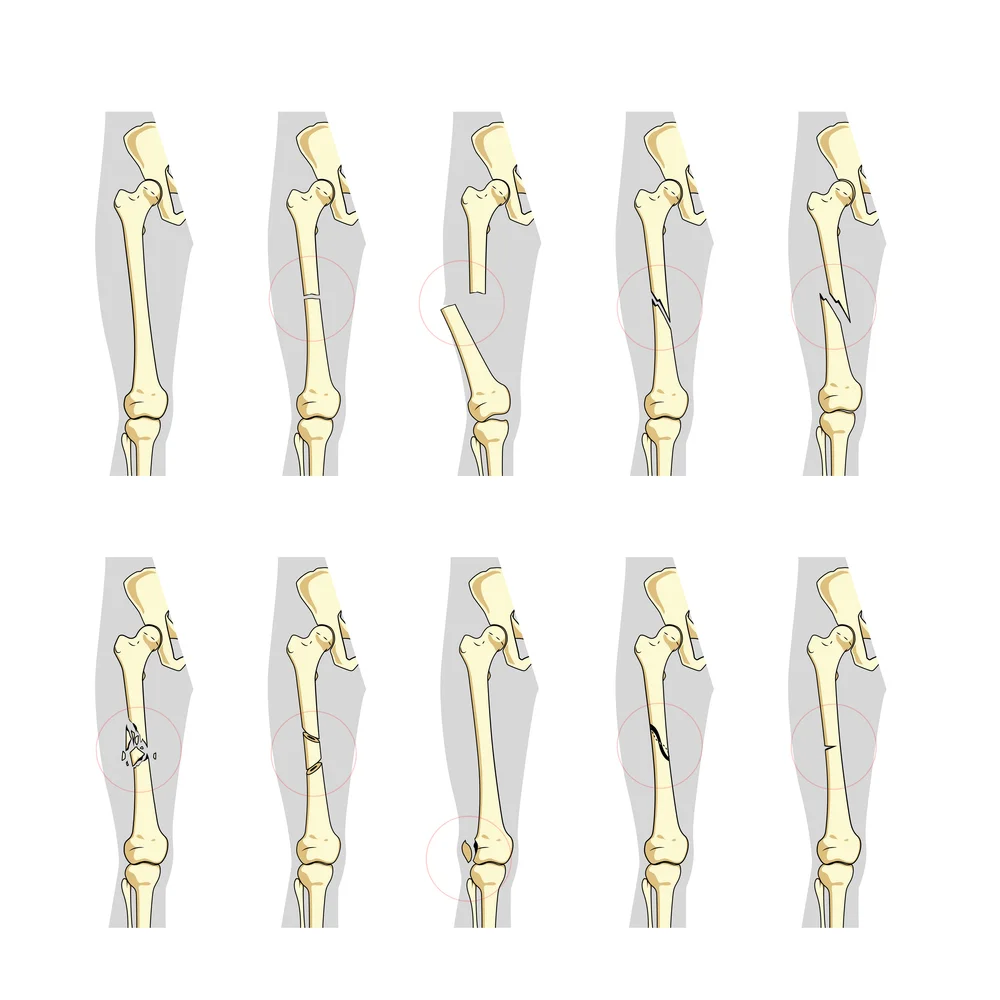
A bone fracture, often called a “broken bone,” occurs when a bone partially or completely breaks under stress or trauma, losing its normal structural continuity.
Fractures are common injuries that can happen to anyone, whether it’s children playing on the playground, or adults involved in accidents, sports, or falls. Since bones support movement, protect organs, and help people move around, a fracture can significantly affect daily life. Being aware of the various types of fractures enables you to understand the severity of the injury and also the type of care needed.
How Fractures Are Classified
Medical experts classify fractures of bones in various ways: according to the nature of the break, cause, stability and alignment, and location.
Following are some of the main classification categories:
Open (compound) vs Closed (simple)
Complete vs Partial (Incomplete)
Stable (nondisplaced) versus Displaced
By fracture pattern — shape or direction of the break
By cause-trauma, repetitive stress, or underlying bone weakness (pathological)
By location – which bone or part of bone is involved
Below, we explore the most common and clinically relevant types of fractures.
Common Types of Bone Fractures
Open [Compound] and Closed [Simple] Fractures
Closed Fracture (Simple): When the bone breaks but the skin does not, it is usually less dangerous from the perspective of infection and almost always has fewer complications than open fractures.
Open fracture: The bone breaks through the skin or a wound exposes the bone. In addition, there are increased risks associated with infection, injuries, bleeding, and soft-tissue injuries.
Open fractures necessitate immediate medical attention because of the greater risk involved.
Transverse, Oblique, Spiral, and Longitudinal Fractures — by Fracture Shape
Fractures may be described based on how the bone has broken:
Transverse fracture-the fracture runs straight across the bone at a right angle to the long axis; often seen following direct trauma.
Oblique fracture: The fracture line runs diagonally across the bone, usually owing to angled or slanted forces.
Spiral fracture: This is a break in a diagonal line winding around the bone, normally occurring due to a twisting or rotational force-for example, from a fall, or during sports.
Longitudinal fracture: This is a fracture that runs along the length of the bone, in the longitudinal direction. Less common, but depending on the direction of the trauma, it’s possible.
These shape-based classifications help the doctors assess how the break occurred and the forces involved, which will, in turn, affect treatment decisions.
Comminuted, Segmental, Impacted – When bones break into multiple pieces
Some fractures are more complex:
Comminuted fracture: when the bone splits into three or more fragments. Most common in high-impact trauma-car accidents and severe falls. Recovery is a lot slower and sometimes complicated.
Segmental fracture: The same bone fractures in two (or more) different locations, leaving a “floating” segment of bone between them. This can compromise stability and requires careful realignment.
Impacted fracture – also referred to as “torus”/“buckle” in some bones: Force pushes the bone ends into each other, jamming the fracture. Fractures usually arise as a result of injury, especially falls and injuries resulting from compressive forces.
The majority of the time, due to the nature of the injured bone, this type of fracture requires a higher level of treatment to obtain appropriate realignment and adequate recovery.
Greenstick, buckle (torus), stress, and compression fractures are examples of partial or subtle fractures.
Not all fractures are dramatic breaks; some are partial or subtle.
Greenstick fracture: The bone bends and partially cracks, but does not break. This happens, especially in children, since their bones are flexible.
Buckle/Torus fracture: This is a form of incomplete fracture whereby one side of the bone buckles under pressure. Commonly occurs in the long bones of children following a fall.
Stress (Hairline) Fracture: Due to repeated stress or low-level overuse, such as long-distance running or repetitive motions. The bone starts developing small cracks that may get worse over time if not treated.
Compression fracture: The bone is crushed or collapsed. Common in vertebrae (spine), especially in people with weaker bones, such as those suffering from osteoporosis.
In most cases, fractures can be very difficult to identify; there will usually be little or no signs of pain or discomfort and therefore, careful assessment is required even when the symptoms do appear to be very mild.
Common Reasons for Fractures
Being aware of what causes fractures allows you to prevent or treat a fractured bone earlier. Here are some of the more common reasons that a fracture could occur.
Trauma: Trauma can be anything from a fall or automobile accident to an injury sustained while playing a sport, to a direct blow to your body. Severe fractures, or very serious fractures, are often related to high-impact trauma.
Repetitive Stress/Overuse: Over time, repetitive actions (such as running and jumping) or repetitive motions (such as continually bending your knee for lengthy periods of time) create micro-fractures in the area of repeated stress which can eventually become stress fractures.
Bony Weakness/Pathological Conditions: Various diseases, such as osteoporosis, infections of the bone, or cancers of the bone, can weaken the bone and make them susceptible to pathological fractures with minimal stress or no apparent trauma.
Age / Bone Growth Factors: Children have more flexible bones, making incomplete fractures (such as greenstick or buckle) more common. In older adults, bone density loss increases risk of compression fractures.
Signs and Symptoms & Why Immediate Medical Attention is Important
Common signs that may indicate a fracture:
Sudden, severe pain in the area of injury.
Swelling, bruising, and tenderness.
Inability to move the affected limb or bear weight. For example, inability to walk if the fracture involves a leg bone.
Visible deformity or abnormal angle of limb.
If bone pierces skin (open fracture), bleeding and wound visible.
This is because fractures may be associated with injuries of surrounding tissues-muscles, nerves, and blood vessels-and therefore require timely medical investigation, imaging (such as X-ray or MRI).
The complications could include infection, especially in open fractures; poor healing of the bone; deformity; or loss of function if proper care is delayed.
What to Do — Initial Steps, Treatment & Healing
If You Suspect a Fracture:
Immobilize the injured area. Do not move it. Do not try to straighten or “fix” the bone yourself
Seek medical care immediately-a proper diagnosis via X-ray or MRI is needed to determine fracture type and plan treatment.
Follow your doctor’s advice; treatment may include:
Casting or splinting to maintain alignment of bones while they heal
Surgical treatment in complicated fractures (comminuted, displaced, open fractures) involves internal fixation with plates, screws, and rods, or external fixation devices.
Rest, restricted weight-bearing, and gradual physiotherapy once healing starts
Healing times depend on the type of fracture, patient age, involved bone, and general health. However, with appropriate care, most fractures will heal properly and full mobility restored.
How a Hospital like Narayani Hospital Can Help
In a multi-specialty hospital setting offering orthopedic care services, such as Narayani Hospital, bone-fractured patients are taken care of comprehensively: from urgent evaluation and imaging to treatment (casting, surgery) and after-care, including physiotherapy.
Having the orthopaedics department equipped with all the necessary facilities ensures that complex fractures-including open, comminuted, or even stress fractures-are appropriately managed by specialists with minimal complications and better prospects of recovery.
In the event of trauma, pain, swelling, or difficulties in moving one’s limbs, for example, get professional assessment as soon as possible. Early intervention improves healing and avoids complications.
Final Thoughts
Understanding the different types of bone fractures-from a simple hairline crack to a complex shattered bone-helps you recognize when to seek urgent care. Even the fractures of the “minor” category, such as stress fractures or greenstick fractures common in children, require attention because fractures that are not treated may get worse or result in other complications. By diagnosing, treating, and following up appropriately, most fractures heal effectively, and the restoration of full mobility becomes possible. If you seek trusted orthopedic and trauma care, hospitals with strong orthopedic services are better equipped with the necessary experience to support recovery, just like Narayani Hospital. Stay safe, and never take any injury to the bones lightly.
great info.