
PCOD vs PCOS: What's the Difference and How Is It Treated?
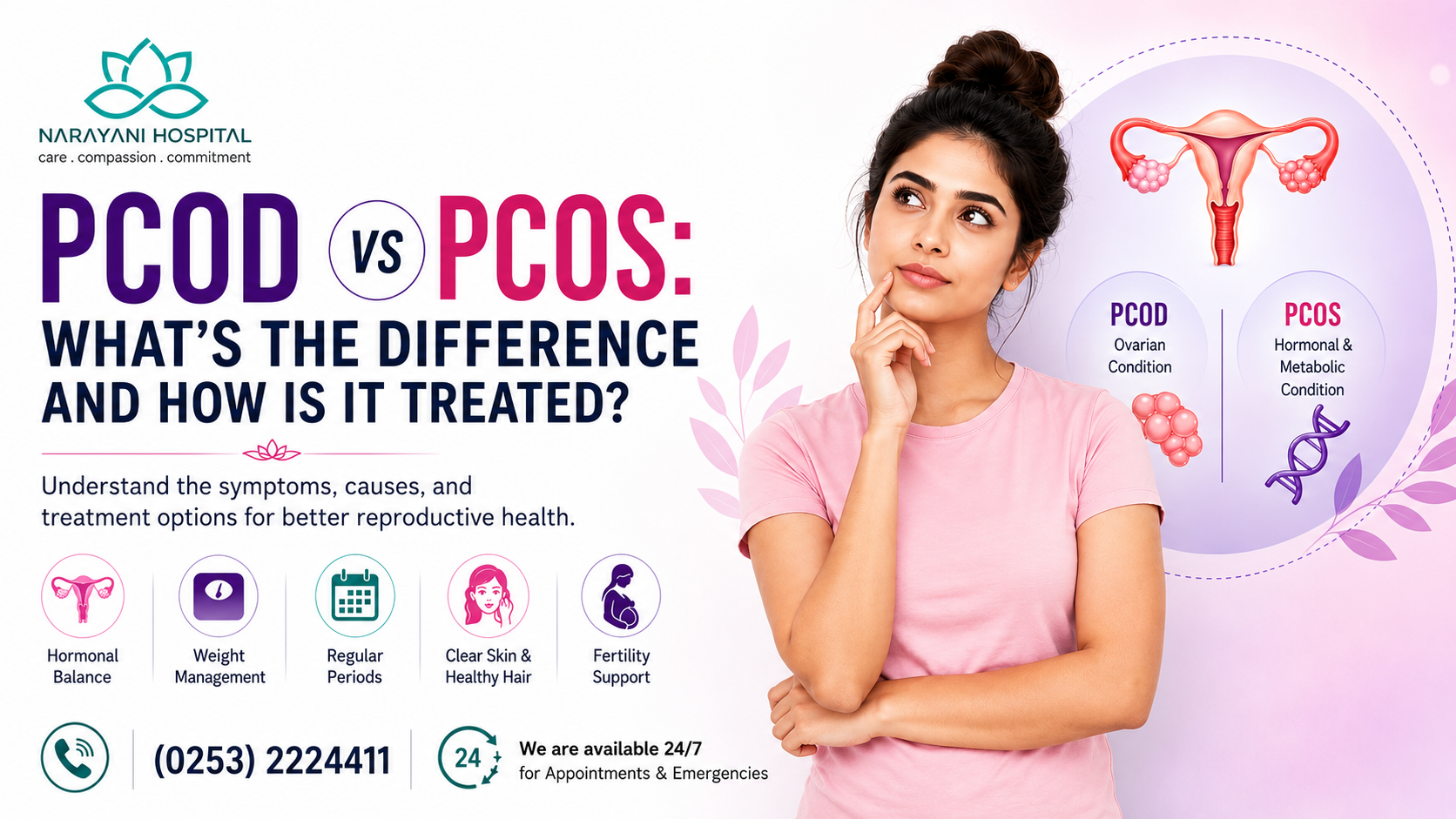
If you've been told you have "PCOD" by one doctor and "PCOS" by another, you're not alone and you're not imagining things either. These two terms get used almost interchangeably in everyday conversation, on social media, and even in some clinics, yet they actually refer to two distinct conditions with different causes, severity levels, and treatment approaches. Understanding the difference matters, because it directly affects how your condition should be managed.
At Narayani Hospital, Nashik, our Gynaecology and Obstetrics department fields this question almost daily. This blog breaks down exactly what separates PCOD from PCOS, how each is diagnosed, and what treatment options actually look like.
What Is PCOD?
PCOD stands for Polycystic Ovarian Disease. It's a condition in which the ovaries produce a large number of immature or partially mature eggs, which eventually turn into cysts. These small, fluid-filled cysts accumulate in the ovaries, causing them to become enlarged and to release excess androgens (male hormones).
PCOD is relatively common a significant percentage of women of reproductive age experience it and it's generally considered the milder of the two conditions. Many women with PCOD can still ovulate, though irregularly, and the condition often responds well to lifestyle changes like diet and exercise.
What Is PCOS?
PCOS stands for Polycystic Ovary Syndrome, and despite the similar name, it's a more complex metabolic and endocrine disorder rather than just an ovarian issue. In PCOS, the ovaries may produce abnormally high levels of androgens, which interferes with the development and release of eggs. Many women with PCOS don't ovulate regularly, or in some cases don't ovulate at all without medical intervention.
PCOS is also strongly linked to insulin resistance, meaning the body's cells don't respond properly to insulin. This can lead to weight gain, difficulty losing weight, and a higher long-term risk of type 2 diabetes, high cholesterol, and cardiovascular disease making PCOS a whole-body condition rather than one confined to the reproductive system.
PCOD vs PCOS: The Key Differences
| Aspect | PCOD | PCOS |
|---|---|---|
| Nature of condition | Ovarian disorder | Metabolic and endocrine syndrome |
| Ovulation | Often irregular but still occurs | Frequently absent or highly irregular |
| Severity | Generally milder | Can be more severe with wider health impact |
| Hormonal imbalance | Present but usually less pronounced | More significant, often insulin-resistance driven |
| Fertility impact | Usually manageable, pregnancy often possible with minor intervention | Can significantly affect fertility, may need more intensive treatment |
| Long-term health risks | Lower risk of associated metabolic conditions | Higher risk of diabetes, heart disease, and endometrial issues if untreated |
| Response to lifestyle changes | Often responds well to diet and exercise alone | May need lifestyle changes plus medical management |
In short: every woman with PCOS technically has polycystic ovaries, but not every woman with polycystic ovaries has the full metabolic syndrome of PCOS. PCOD is more of an ovarian condition; PCOS is a broader hormonal and metabolic disorder that happens to involve the ovaries.
Common Symptoms Shared by Both
Because PCOD and PCOS overlap so much, they often present with similar symptoms, which is part of why the two get confused so easily:
- Irregular or missed periods
- Excessive facial or body hair growth (hirsutism)
- Acne, especially along the jawline
- Thinning hair or hair loss on the scalp
- Weight gain, particularly around the abdomen
- Difficulty losing weight
- Dark patches of skin, often around the neck or underarms
- Mood swings or fatigue
- Difficulty conceiving
If you're experiencing several of these symptoms together, especially irregular periods combined with weight changes or excess hair growth, it's worth getting evaluated rather than assuming it's "just stress" or "just genetics."
How Are PCOD and PCOS Diagnosed?
Diagnosis typically involves a combination of:
- Medical history and symptom review: including menstrual cycle patterns, weight changes, and family history.
- Physical examination: checking for signs like excess hair growth, acne, or skin changes.
- Blood tests: to check hormone levels (including androgens, LH, FSH, and insulin), blood sugar, and cholesterol.
- Ultrasound: to examine the ovaries for the presence of multiple small cysts and to assess their size.
Because PCOS involves broader metabolic changes, doctors often also screen for insulin resistance and related risk factors as part of a complete diagnostic picture.
How Is PCOD Treated?
Treatment for PCOD tends to focus on restoring hormonal balance and regular ovulation through:
- Dietary changes: reducing processed sugar and refined carbohydrates, increasing fibre and protein intake
- Regular physical activity: even moderate exercise can significantly improve symptoms
- Weight management: losing even 5-10% of body weight can restore regular ovulation in many cases
- Medications: when needed, to regulate the menstrual cycle or manage specific symptoms like acne or excess hair growth
Many women with PCOD see meaningful improvement with lifestyle changes alone, without needing long-term medication.
How Is PCOS Treated?
Because PCOS involves both reproductive and metabolic components, treatment is usually more comprehensive:
- Lifestyle modification remains the foundation diet, exercise, and weight management are just as important here, often more so, because of the insulin resistance component
- Medications to manage insulin resistance, which can also help with weight and hormonal balance
- Hormonal treatments to regulate periods and reduce androgen-related symptoms like acne and excess hair growth
- Fertility treatment, when pregnancy is desired and ovulation isn't occurring naturally, ranging from ovulation-inducing medication to more advanced fertility support
- Long-term monitoring for associated risks like diabetes, high cholesterol, and endometrial health, given the broader metabolic nature of the condition
At Narayani Hospital, our Gynaecology and Obstetrics team, led by Dr. Mayuri Kelkar, takes an individualised approach to both conditions because no two women present with exactly the same combination of symptoms, hormone levels, or fertility goals. Whether the priority is regulating periods, managing symptoms like acne or hair growth, or planning a pregnancy, treatment is tailored accordingly, with close attention to long-term metabolic health as well.
Can PCOD or PCOS Be Cured?
Neither condition currently has a definitive "cure," but both can be very effectively managed. With the right combination of lifestyle changes and medical care, most women with PCOD or PCOS can achieve regular cycles, manageable symptoms, and, when desired, successful pregnancies. The key is early diagnosis and consistent management rather than waiting for symptoms to worsen.
When Should You See a Doctor?
You don't need to wait for a fertility concern to bring these symptoms up. Consider consulting a gynaecologist if you notice:
- Periods that are consistently irregular, absent, or unusually heavy
- Sudden or excessive weight gain that's hard to explain
- New or worsening acne, hair growth, or hair thinning as an adult
- Difficulty conceiving after several months of trying
Early evaluation makes a real difference both in managing symptoms day-to-day and in reducing long-term health risks.
Book a Consultation at Narayani Hospital, Nashik
Whether you're dealing with irregular periods, trying to understand a recent diagnosis, or planning for pregnancy, our Gynaecology and Obstetrics team is here to guide you through it with clarity and care.
Narayani Hospital is located at Mumbai Naka, Deepali Nagar, Nashik. Walk-ins are welcome, and same-day appointments are available.
📞 Call us at (0253) 2224411 to book a consultation or for any emergency our team is available 24/7.
Call NowFrequently Asked Questions
Q: Is PCOS worse than PCOD?
Ans: Generally, yes. PCOS involves broader hormonal and metabolic changes, including insulin resistance, and carries higher long-term risks for conditions like diabetes and heart disease compared to PCOD.
Q: Can I get pregnant if I have PCOD or PCOS?
Ans: Yes, pregnancy is possible with both conditions. PCOD often requires minimal intervention, while PCOS may need more structured fertility support, especially if ovulation is irregular or absent.
Q: Is PCOD or PCOS caused by an unhealthy lifestyle?
Ans: Lifestyle factors like diet and physical activity can influence symptoms and severity, but both conditions are primarily driven by hormonal and genetic factors, not lifestyle alone.
Q: Can weight loss cure PCOD or PCOS?
Ans: Weight loss can significantly improve symptoms and, in some cases of PCOD, restore regular ovulation entirely. However, it isn't a guaranteed cure, especially for PCOS, which often needs ongoing management.
Q: Which doctor should I consult for PCOD or PCOS in Nashik?
Ans: A gynaecologist is the right specialist to diagnose and manage both conditions. At Narayani Hospital, Dr. Mayuri Kelkar and the Gynaecology and Obstetrics team provide evaluation, treatment, and fertility guidance for PCOD and PCOS.